
SEA Program Update
Updates to the SEA Policy Map and SEA Ordinance are proposed to align with the proposed policy revisions in the CNR Element.
2025 SEA Study
The 2025 SEA Study was conducted to inform the CNR Element Update to comply with SB 1425 and AB 1889. The objective of the 2025 SEA Study was to ensure that the biodiversity of the SEAs remain healthy and address climate resiliency, rewilding, and wildlife connectivity in the SEAs. The 2025 SEA Study is available for reference along with prior SEA studies. The 2025 SEA Study evaluated:
- SEA boundaries to ensure that the SEAs are functioning as planned.
- If the SEAs still accommodated natural biological processes, habitat linkages and corridors, and are sized sufficiently.
- Current day issues, such as edge effects from encroaching development, and how habitats can adapt to climate change.
- New information available since 2000 on rare and sensitive species were incorporated.
Visit the SEA Program Resources page to view the 2025 SEA Study: https://planning.lacounty.gov/long-range-planning/significant-ecological-areas-program/resources/
SEA Policy Map Update
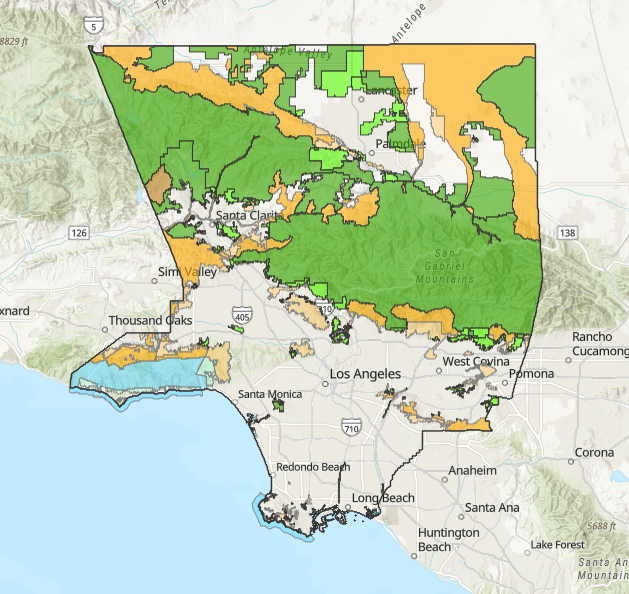
The proposed revisions to the SEA Policy Map were informed by the 2025 SEA Study. The SEA Policy Map provides the boundaries where the General Plan policies and zoning regulations will apply.
Visit the Documents page to review the Draft SEA Policy Map (CNR Element Figures): https://planning.lacounty.gov/long-range-planning/cnr/documents/
SEA Ordinance Update
The proposed revisions in the SEA Ordinance Update were made to meet requirements from the state legislation, and align with proposed CNR policies and results from the SEA Study. Adjustments to the ordinance provide clarifying revisions to development standards and permit processes.
Visit the Documents page to review the Draft SEA Ordinance revisions: https://planning.lacounty.gov/long-range-planning/cnr/documents/
Look up your property on the SEA map
An interactive online map is available to explore the proposed boundary revisions and read the descriptions and ecological justification. You can search by Assessor Identification Number (from your property tax bill) or property address to see if your property is within a proposed SEA.
Frequently Asked questions
GENERAL
SEAs, or Significant Ecological Areas, are areas that have been determined to contribute to maintaining the biodiversity of Los Angeles County. More information on the SEA Program can be found at: planning.lacounty.gov/sea
Recent State legislation, Senate Bill 1425 (Stern, 2022) and Assembly Bill 1889 (Friedman, 2024), requires local governments to improve access to open spaces, enhance wildlife connectivity, and support biodiversity by mitigating the impacts of human activities on natural habitats. The County will implement these requirements, in part, through the SEA Program.
The proposed SEAs and updates to the SEA Ordinance are currently drafts and available for public review and comment. It must then go through public hearings before they can be adopted. Public hearings have not yet been scheduled. Notices for public hearings will be published in local newspapers, and email notifications will be sent to the project’s email list. It is strongly recommended that you register on the email list for notifications at: planning.lacounty.gov/cnr.
The proposed SEA boundaries were informed by a countywide study that looked at where important biological resources, habitats, and wildlife movement areas are located. The boundaries were then proposed based upon locations meeting one or more of the selection criteria established by the SEA Program.
SEAs shown within incorporated cities are mapped for informational purposes only and help illustrate regional ecological connectivity and areas that support local biodiversity. The County's SEA Ordinance is part of the County's Zoning Code and applies only to properties located in unincorporated Los Angeles County. The SEA Ordinance does not apply to properties within incorporated cities.
PROPERTY VALUE AND TAXES
The SEA designation does not change how property taxes are calculated. In California, property taxes are governed by Proposition 13, which limits the general property tax rate to 1% of a property’s assessed value (plus bonded indebtedness and direct assessment taxes). The SEA designation does not change this process.
The SEA designation does not change how the County Assessor determines assessed value under Proposition 13. Under Proposition 13, a property’s assessed value is generally based on its value at the time of purchase and may increase by no more than 2% per year, unless there is a change in ownership or new construction.
Property value in the real estate market may be influenced by many factors including location, access, and utilities. However, the SEA designation itself does not change the Proposition 13 valuation process or automatically reassess a property’s value.
VEGETATION MANAGEMENT
Annual defensible space and weed abatement activities required by the Fire Department or Agricultural Commissioner Weights and Measures are exempt and do not need approval from the Planning department. This is because it is legally required, approved by the Fire Department, and associated with existing permitted structures for fire protection purposes. This exemption does not include tilling or discing.
If your property is located within a SEA, vegetation removal that is not associated with required defensible space or weed abatement may require SEA review, specifically if it involves native vegetation, undisturbed areas containing native vegetation, or areas that may provide habitat for species, since this may be considered “development” under the SEA Ordinance.
Property owners are strongly encouraged to contact County staff before removing any vegetation to confirm and determine if any County or State permits may be required.
BUILDING AND PERMITTING
Yes, you can still build on your property even if it is designated as a SEA. Development is still allowed as long as it is consistent with the property’s zoning and in compliance with the SEA Ordinance.
This means during the permitting process the project design is reviewed to avoid or reduce impacts on biological resources. Prior to submitting plans, a pre-application counseling meeting will be required to evaluate the biological resources on the property. During this process, County staff can help guide the project design to avoid or reduce impacts as much as possible, which may also help the project qualify for a simple permitting process.
Property owners should first verify the property’s zoning and confirm water availability and legal/physical access to the property. These items are important to understand early because they may affect whether the proposed project is possible, regardless of other regulations.
DEVELOPED PROPERTIES
If your property already has existing permitted development and you do not plan to make changes, the SEA designation generally does not affect your current use of the property. You may continue to use, repair, and maintain the existing permitted structures and infrastructure. Like-for-like replacement of existing permitted structures or improvements is generally exempt, provided the replacement does not expand the existing footprint or result in new impacts to biological resources.
However, new development such as building additions that expand the footprint, grading undisturbed areas containing native vegetation, vegetation removal not associated with defensible space, or other substantial changes to the property that are considered “development” under the SEA Ordinance may require SEA review.
VACANT PROPERTIES
If your property is vacant and you do not plan to develop or make changes to the property, the proposed SEA designation generally would not affect your property.
If you plan to develop a vacant property, SEA review may be required as part of the permitting process. Activities such as new development, grading undisturbed areas containing native vegetation, vegetation removal not associated with defensible space, or other substantial changes to the property that are considered “development” under the SEA Ordinance may require SEA review.
In addition, property owners may also need to comply with other existing County applicable development requirements. These may include hillside development standards, septic requirements, fire access and fuel modification requirements, and other environmental or development regulations that may apply to the property.